What To Really Look For In Your Marketing Performance Report
Published May 1, 2026
At first glance, most marketing performance reports appear healthy. Website traffic is climbing, click-through rates look solid, and return on ad spend (ROAS) meets or exceeds internal benchmarks. But here’s the uncomfortable truth. Many of the metrics that look the most impressive are often the least connected to real business growth.
If your marketing report focuses primarily on surface-level performance indicators, you may be missing what truly matters. Modern marketing success isn’t about tracking activity, it’s about understanding impact. Knowing what to really look for in your marketing performance report can help you make smarter decisions, allocate budget more effectively, and clearly demonstrate value to leadership.
Why Traditional Marketing Metrics Fall Short
For years, marketing teams relied on a familiar set of metrics. Organic traffic, keyword rankings, impressions, click-through rates, and ROAS. These metrics became standard because they were easy to measure and easy to communicate.
But the digital landscape has evolved. Today’s customer journey is more complex, fragmented, and less trackable than ever before. Buyers interact with brands across multiple platforms, social media, video content, AI-generated search summaries, and private messaging channels, many of which don’t feed clean data into analytics platforms.
As a result, traditional metrics often reflect what’s measurable, not what’s meaningful.
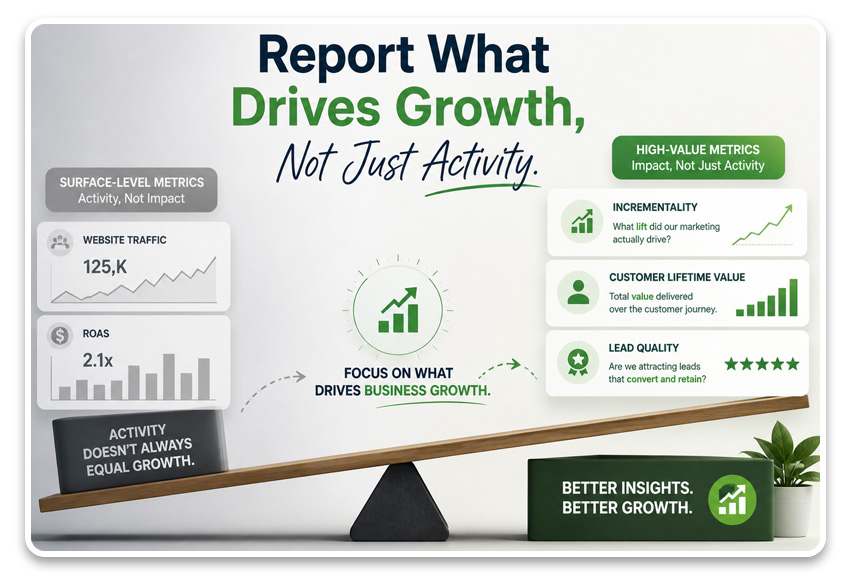
A spike in website traffic, for example, may look like success on paper. But if that traffic isn’t converting into qualified leads or revenue, its value is limited. Similarly, a high ROAS might suggest efficiency, but it doesn’t necessarily prove that your marketing efforts are driving new demand.
The Shift from Activity to Impact
The most important shift happening in marketing measurement today is the move from tracking activity to evaluating impact.
Activity-based metrics answer questions like:
- How many people visited the site?
- How many clicks did this campaign generate?
- What was the cost per conversion?
Impact-based metrics, on the other hand, answer deeper, more strategic questions:
- Did this campaign generate new demand?
- Would these conversions have happened without this marketing effort?
- Is marketing improving the long-term value of customers?
Understanding this distinction is critical. A campaign can perform well in terms of activity while contributing very little to actual business growth.
The Problem with Attribution Models
Marketing attribution has long been used to connect marketing efforts to conversions. While it can provide useful insights, it has limitations that are often overlooked. Most attribution models, especially last-click models, assign credit to the final interaction before a conversion. This creates a bias toward channels that capture existing demand rather than those that generate it.
For example, paid search campaigns often receive credit for conversions when users search for a brand name. But that search behavior may have been influenced by earlier touchpoints, such as a video ad, social media content, or word-of-mouth recommendations.
Attribution tells you what happened before a conversion, but it doesn’t prove that marketing caused the conversion. That distinction matters when making strategic decisions about where to invest your marketing budget.
Why ROAS Doesn’t Tell the Full Story
Return on ad spend (ROAS) is one of the most widely used marketing metrics, but it can be misleading if taken at face value. ROAS is typically presented as a single number, averaging performance across an entire campaign or channel. However, this average can hide important details about diminishing returns.
For instance, the first portion of your ad spend may generate strong returns, while additional spending produces significantly lower results. When combined, the overall ROAS may still look healthy, masking inefficiencies in your budget allocation.
ROAS doesn’t account for the source of demand. If your ads are capturing users who were already likely to convert, the metric may overstate the true impact of your marketing efforts.
What to Focus on Instead
To get a more accurate picture of performance, your marketing report should prioritize metrics that reflect real business outcomes.
1. Incremental Growth
One of the most valuable metrics to track is incrementality, measuring the outcomes that would not have occurred without your marketing efforts.
This helps answer the critical question: is marketing creating new demand, or simply capturing existing demand? Incrementality testing, controlled experiments, and advanced modeling techniques can provide deeper insights into true performance.
2. Branded Demand Growth
An increase in branded searches and direct traffic often indicates that your marketing is building awareness and influencing buyer intent. When more people actively seek out your brand, it’s a strong signal that your marketing is working beyond just immediate conversions.
3. Customer Lifetime Value (LTV)
Focusing on long-term customer value rather than short-term conversions is essential for sustainable growth. Metrics like lifetime value (LTV), repeat purchase rate, and customer retention provide insight into whether your marketing efforts are attracting high-quality customers.
4. Customer Acquisition Cost (CAC) and Payback Period
Understanding how much it costs to acquire a customer, and how long it takes to recover that cost, is key to evaluating profitability. A campaign that generates low-cost leads may seem efficient, but if those leads don’t convert into valuable customers, the investment may not be worthwhile.
5. Lead and Conversion Quality
Not all conversions are created equal. A high volume of low-quality leads can strain sales teams and reduce overall efficiency. These indicators provide a clearer picture of how marketing contributes to revenue. Your marketing report should include metrics that assess lead quality, such as:
- Lead-to-close rates
- Revenue per lead
- Sales cycle length
Rethinking Traffic and Engagement Metrics
Traffic and engagement metrics still have a place in your reporting, but they should be treated as diagnostic tools, not primary success indicators. These metrics should support your analysis, not define it. For example:
- Traffic trends can help identify visibility issues
- Engagement metrics can highlight content effectiveness
- Click-through rates can signal ad relevance
Aligning Marketing Reports with Business Goals
Ultimately, your marketing performance report should align with what business leaders care about most. Growth, profitability, and long-term value. When your report clearly connects marketing efforts to business results, it becomes a powerful tool for decision-making, not just a collection of numbers. This means shifting the focus from:
- Volume to value
- Activity to outcomes
- Efficiency to effectiveness
Prager Understands Digital Marketing and What Defines Success
Marketing performance reporting is evolving, and the metrics that once defined success are no longer enough on their own. To truly understand what’s working, you need to look beyond surface-level data and focus on indicators that reflect real impact. By prioritizing incremental growth, customer value, and demand creation, you can build a marketing report that not only looks good, but actually drives smarter strategy and better results. Contact the SEO and conversion marketing pros at Prager today to discuss all your digital marketing needs.