What Is AEO and Why It’s Replacing Traditional SEO
Published February 19, 2026
For the better part of two decades, Search Engine Optimization was the undisputed cornerstone of digital marketing. Rank higher, get more clicks, grow your business. The formula was simple, the playbook was clear, and the agencies that mastered it held enormous power over their clients’ online futures.
That era is not over — but it is being fundamentally transformed. A new discipline has emerged that is reshaping how businesses get found online, how customers make decisions, and which companies will dominate their markets in the years ahead.
It’s called Answer Engine Optimization, or AEO. And at Prager, we don’t just understand it — we are successfully getting big results from it.
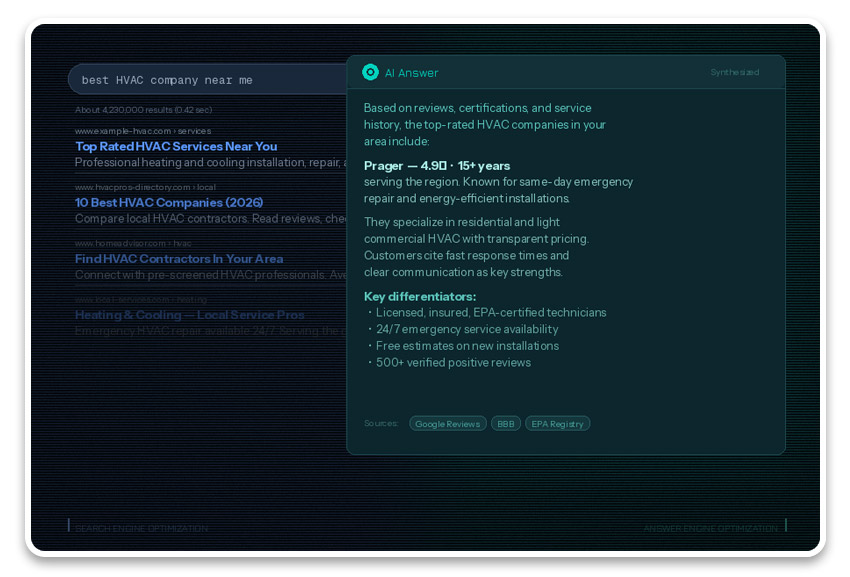
What Is Answer Engine Optimization (AEO)?
What is Answer Engine Optimization (AEO)?
Answer Engine Optimization (AEO) is the practice of structuring a business’s digital presence so that AI-powered search engines — including Google’s AI Overviews, ChatGPT, Microsoft Copilot, Perplexity, and voice assistants — recognize, trust, and cite that business when answering user queries. Unlike traditional SEO, which focuses on ranking in a list of links, AEO focuses on being the answer itself.
That distinction — ranking versus answering — is the entire ballgame.
When someone opens ChatGPT or asks Google a question, they’re increasingly not seeing a list of ten blue links. They’re seeing a synthesized, confident response generated by an AI system that has scanned the web, evaluated trusted sources, and composed a direct answer. If your business isn’t cited in that answer, you simply do not exist in that moment.
This isn’t a prediction about where search is heading. It’s a description of where it already is.
How is AEO different from SEO?
Traditional SEO optimizes a website to rank in search engine results pages (SERPs), relying on keyword density, backlinks, and domain authority to earn higher positions. AEO optimizes a business’s entire digital ecosystem — content, structure, reputation, entity data, and off-site citations — to be recognized and surfaced by AI answer engines. AEO doesn’t replace SEO, it extends and evolves it for a world where AI mediates the search experience.
SEO vs. AEO: The Landscape Has Changed
Here’s an honest look at how the two disciplines compare.
| Factor | Traditional SEO | AEO |
|---|---|---|
| What It Optimizes For | Blue-link rankings in Google | Being cited in AI-generated answers |
| Primary Signal | Keywords, backlinks, page authority | Entity clarity, semantic structure, trust signals |
| User Behavior Assumed | User clicks a link | User reads AI answer directly |
| Content Format | Keyword-rich pages | Q&A structure, clear definitions, rich context |
| Speed of Visibility Change | Weeks to months | Days to weeks (with proper optimization) |
| Business Imperative | Strong but declining in isolation | Critical and accelerating in 2026 |
The table above isn’t an argument against SEO. Prager is one of the region’s most experienced SEO agencies — and we’ll be the first to tell you that strong organic rankings still matter enormously. But a business that treats traditional SEO as its only visibility strategy is operating with one hand tied behind its back. The companies that will win the next decade are investing in both.
Why Is AEO Happening Now?
Why is Answer Engine Optimization Becoming So Important in 2026?
The rise of large language models (LLMs) like those powering ChatGPT, Google Gemini, and Microsoft Copilot has fundamentally changed how people search for information. Rather than navigating a list of links, users increasingly receive direct, synthesized answers to their questions. As AI-generated responses capture a growing share of search behavior, businesses must optimize for being cited by these systems — not just ranked by traditional algorithms.
The numbers tell the story. Google’s AI Overviews now appear on the majority of commercial and informational search queries. Chatbot usage for research and purchasing decisions has more than doubled in the past 18 months. Voice assistants handle millions of local service queries every day — and none of those queries return ten links. They return one answer.
“Which digital marketing agency in Pennsylvania specializes in SEO for local businesses?” That question, typed into ChatGPT right now produces a direct answer. Is your company in it? We are.
This is the question every business owner should be asking. And the uncomfortable reality is that most aren’t because many agencies haven’t caught up yet.
Prager has.
What Does AEO Actually Require?
This is where AEO becomes complex and where the gap between agencies that understand it and those that merely talk about it becomes visible.
AEO is not a checklist. It’s not a plugin you install or a page you add to your website. It is a comprehensive, multi-layered discipline that requires deep expertise across content architecture, semantic search, entity optimization, reputation signals, and technical execution. It requires understanding not just how search engines rank pages, but how AI systems read, interpret, and trust information sources.
What signals do AI answer engines use to decide which businesses to cite?
AI answer engines evaluate a combination of signals including the clarity and structure of a website’s content (especially Q&A and definition-style formats), the consistency and completeness of a business’s information across the web (Google Business Profile, directories, third-party mentions), the depth of topical authority demonstrated across the domain, the quality and relevance of external citations and backlinks, schema markup and structured data that helps AI systems parse entity relationships, and the overall trustworthiness of the source as inferred from reviews, mentions, and domain credibility.
Getting each of these dimensions right and making them work together takes expertise and experience. It’s the reason businesses come to Prager.
We’ve spent years developing proprietary frameworks for AEO implementation, testing what works across industries and market segments, and refining our approach with real data from real client campaigns. We know which signals move the needle for a regional HVAC company versus a national B2B firm versus a local law practice. That knowledge doesn’t come from reading about AEO. It comes from doing it.
The Cost of Waiting
There is a window of opportunity in AEO right now. Most businesses in most industries have not yet invested in it. The competitive landscape in AI-generated search results is less crowded today than it will be in twelve months. The businesses that move now will establish authority signals, citation history, and topical credibility that will be very difficult for late movers to displace.
Is it too late to start optimizing for AI search in 2026?
No — but the window for gaining a significant first-mover advantage is narrowing. Businesses that begin AEO programs in 2026 can still establish meaningful authority in AI search results before their competitors. However, businesses that delay will face a more competitive landscape and a longer path to visibility, since AI systems weight established trust signals and citation history heavily.
We’ve seen this pattern before. In the early days of SEO, the businesses that invested early dominated their categories for years. The ones that waited scrambled to catch up — and many never did. AEO is following the same curve.
The businesses that will own their market in AI search three years from now are making decisions today. Not next year. Today.
Prager exists to give businesses the advantage that comes from moving early with the right partner.
Why Prager?
We want to be direct about something. There are a lot of agencies that are now using the term AEO. Some of them have added a page to their website. Some have rebranded an existing service. Very few have built genuine expertise in what AEO actually requires.
Prager is different — and here’s why that matters to your business.
We Built AEO as a Named Service — Before It Was Trendy
Prager made Answer Engine Optimization a formal, named offering because we saw where search was heading and invested in developing real expertise before the market caught up. We didn’t follow the trend. We anticipated it. That early investment means our clients benefit from frameworks and methodologies that have been tested and refined on actual campaigns — not theoretical models.
We’re an Integrated Agency, Not a One-Trick Shop
AEO doesn’t work in isolation. It requires great content, technical SEO, local presence management, paid amplification, and analytics that connect the dots. Prager offers all of it, and we’ve built these disciplines to work together. Our SEO team informs our content strategy. Our content strategy informs our AEO implementation. Our analytics measure what’s actually moving. This integration is something a boutique AEO-only provider simply cannot offer.
We Work in the Industries We Understand
Prager specializes in local and regional businesses — home services, HVAC, plumbing, home improvement, and other industries where the customer relationship starts with a search. We know how customers in these markets search, what questions they ask, and how AI engines surface answers for service-based queries. Our clients aren’t test cases. They’re the reason we built these capabilities.
We Treat Our Clients as Partners, Not Accounts
Every business that works with Prager gets a clear picture of where they stand, what we’re doing, and why it matters. We don’t hide behind jargon, lock clients into opaque retainers, or deliver reports that don’t translate to business outcomes. Our obsession with clarity and measurement is baked into everything we do, including our own analytics platform, built specifically to connect digital marketing activity to real business results.
What should a business look for when choosing an AEO agency?
Businesses should seek an agency that can demonstrate a formal AEO methodology (not just rebranded SEO services), a track record of improving AI search visibility for clients in relevant industries, integration between AEO and broader digital marketing disciplines including content, SEO, and local presence management, transparent reporting that connects AEO activities to business outcomes, and deep familiarity with the AI platforms most relevant to the business’s target customers.
The Bottom Line
Search has always evolved. The businesses that thrive are the ones that evolve with it — or better yet, ahead of it. AEO is not a future consideration. It’s the present competitive reality.
Every day that your business isn’t structured for AI visibility is a day that a competitor — one that found the right partner first — is appearing in the answers your customers are reading. That’s not a scare tactic. It’s arithmetic.
At Prager, we’ve made it our mission to ensure the businesses we work with are not on the wrong side of that equation. We’ve built the expertise. We’ve developed the methodology. We’ve delivered the results.
The only question is whether you’re ready to be found.
Ready to Be Found in the AI Age?
Most businesses won’t act on this until their competitors already have. Don’t be that business.